
The National Museum of Modern and Contemporary Art will present the first large-scale solo exhibition in Asia by British visual artist Damien Hirst. This exhibition spans the artist’s practice from his early works to recent pieces and features a wide range of media, including installation, sculpture, and painting.
The exhibition examines the core themes that Hirst has continuously explored throughout his career: death and immortality; humanity’s beliefs and desires surrounding science and medicine; and the tension between artistic value and market logic. Through these themes, the exhibition aims to create a broad platform for discourse on life and values in contemporary society.
The presentation includes major works such as the Natural History series, in which dead animals are preserved in formaldehyde tanks, and For the Love of God (2007), alongside newly unveiled works created after the Cherry Blossoms series. By bringing together iconic pieces and previously unreleased recent works, the exhibition offers an in-depth introduction to Hirst’s artistic world, which persistently questions the systems, institutions, and belief structures that shape society.
National Museum of Modern and Contemporary Art, Korea
https://www.mmca.go.kr/exhibitions/exhibitionsDetail.do?exhFlag=2
Exhibition Information (English)
- Period: March 20, 2026 – June 28, 2026
- Organized / Sponsored by: Not specified
- Venue: Basement Level 1 (Galleries 3, 4, and 5), 2nd Floor (Gallery 8), Basement Level 1, Seoul Box
- Admission Fee: 8,000 Won
- Artist: Damien Hirst


Damien Hirst

Damien Hirst is a British contemporary artist best known for his provocative approach to art that confronts themes of life, death, belief, science, and the art market itself. He is widely recognized as a leading figure of the Young British Artists (YBAs), a group that reshaped the global perception of British art in the 1990s.
Background and Career
Damien Hirst was born in 1965 in Bristol, England, and studied Fine Art at Goldsmiths, University of London. During his student years, he demonstrated not only artistic ambition but also strong curatorial and organizational skills, which helped him gain early visibility.
His breakthrough came in the early 1990s when his work attracted the attention of major collectors and institutions. Since then, Hirst has remained one of the most influential and controversial figures in contemporary art.
Influence and Legacy
Damien Hirst has played a significant role in redefining how contemporary art is produced, marketed, and consumed. Beyond individual artworks, his career highlights broader questions about authorship, value, and the structures of the global art system.
Today, he is regarded not only as an artist but also as a symbol of how contemporary art intersects with commerce, media, and public discourse.
Artistic Themes and Approach
Hirst’s work consistently explores:
- The inevitability of death and human mortality
- The relationship between science, medicine, and belief
- Systems, repetition, and industrial production
- The role of money, branding, and value in art
He often emphasizes ideas over craftsmanship, aligning his practice with conceptual art traditions.
Representative Works and Series
The Formaldehyde Animal Installations
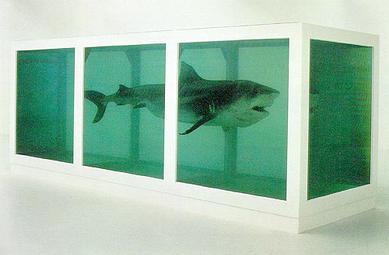
Hirst’s most famous works involve real animals preserved in formaldehyde and displayed in glass vitrines.
- Representative work: The Physical Impossibility of Death in the Mind of Someone Living (1991)
- Description: A tiger shark suspended in a tank of formaldehyde
- Interpretation: The work confronts viewers with death as a physical presence while highlighting the impossibility of fully comprehending it while alive
This series established Hirst’s international reputation and sparked significant ethical debate.
Spot Paintings

The Spot Paintings are composed of evenly spaced, brightly colored dots arranged in grid-like patterns.
- Key characteristics: Systematic repetition, absence of visible emotion
- Conceptual focus: Scientific order, pharmaceutical culture, control, and chance
- Notable aspect: Many were produced by studio assistants, raising questions about authorship and originality
Butterfly Paintings
Hirst has repeatedly used butterfly wings, either individually or arranged in symmetrical patterns.
- Symbolism: Beauty, transformation, spirituality, and death
- Visual impact: Decorative and almost religious in composition
- Conceptual tension: The use of fragile, real materials contrasts with the theme of mortality
Controversy and Critical Debate
Hirst’s work has generated ongoing debate due to:
- The use of real animals in artworks
- The industrial scale of production
- The close relationship between his art and the commercial art market
Supporters view these elements as a critical reflection of contemporary society, while critics question the ethical and artistic implications.